
· Singapore AI Observatory · Analysis · 5 min read
Singapore tops the world in Claude usage intensity: what 5.53 means
Anthropic's March 2026 Economic Index ranks countries by Claude usage intensity, normalized by population, and Singapore comes first at 5.53. The number measures per-capita adoption intensity — not absolute volume, and not how advanced the usage is. Singapore's top spot rests on a sustained policy push and on its base as a small, rich, English-speaking, knowledge-worker-dense city-state.
The Economic Index report Anthropic released in March 2026 came with a country-by-country ranking of AI usage intensity. Singapore sits at the top, at 5.53.
That 5.53 measures per-capita intensity. Its full name is the Anthropic AI Usage Index (AUI), and the formula is a ratio: a region’s share of global Claude usage divided by its share of the global working-age population. The baseline is 1 — if everyone of working age worldwide used Claude equally, Singapore would account for exactly 1 share. It actually accounts for 5.53.
Absolute volume is a different matter. In this sample, 5,499 conversations came from Singapore — far fewer than from population giants like the United States and India. Singapore wins on density: for the same ten thousand working people, its Claude usage intensity runs more than five times the global average.
Alongside the ranking, the tool lists the tasks where Singapore runs above the global average. Near the top are creating teaching materials (1.4×), developing and debugging machine-learning and AI systems (1.3×), scientific research (1.3×), and solving math problems (1.2×). By occupation, Computer and Mathematical accounts for 17.9% of Singapore’s conversations, and Education for 8.2%.
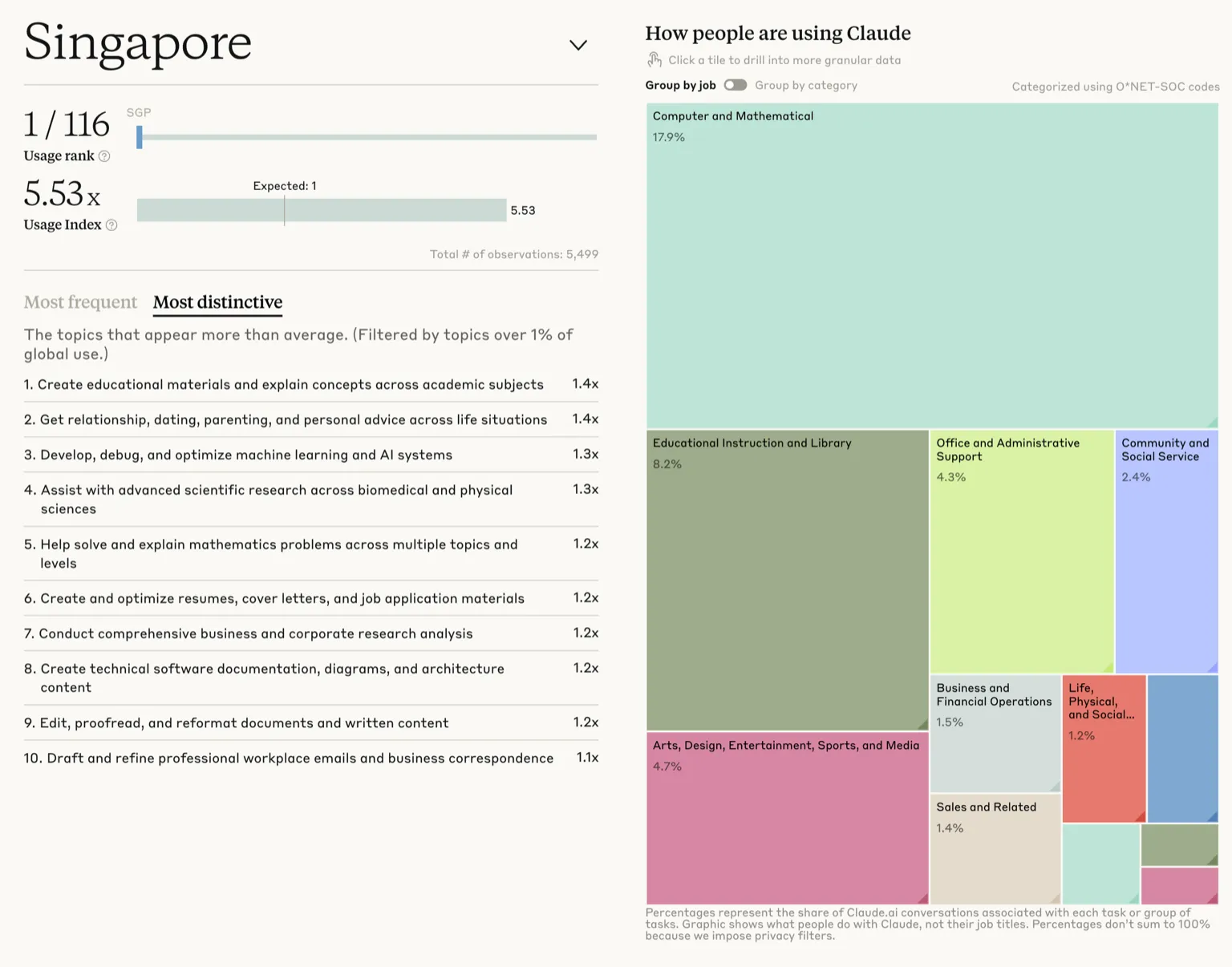
Anthropic’s Economic Index page for Singapore: usage-intensity rank 1/116, Usage Index 5.53, 5,499 sampled conversations; the right panel breaks usage down by occupation, with Computer and Mathematical at 17.9%.
Why Singapore
Because the AUI uses working-age population as the denominator, the formula favors economies that are small, rich, English-speaking, and urban. Singapore is a city-state, with no large stretches of low-income, poorly connected countryside to drag down its per-capita figure. The national averages for the United States and India spread tech peaks like San Francisco and Bangalore across vast regions where adoption is very low. Singapore as a whole is the equivalent of someone else’s single first-tier city, so its per-capita figure is naturally high. On top of that, English is the working language, so an English-first tool like Claude has no barrier to entry; incomes are high, knowledge workers cluster, and finance and technology happen to be the two industries where Claude is used most heavily. The report sums it up in one line: Claude is used most heavily in high-income countries and in places dense with knowledge workers. Singapore fits these conditions closely.
In a separate report from the Microsoft AI Economy Institute, Singapore’s generative-AI adoption rate ranks second in the world, at 60.9%. Measure it with another company’s numbers, and Singapore is still right at the front.
All of that is just the foundation. Singapore released the first National AI Strategy in 2019, updated it to 2.0 in 2023, and in May 2026 announced four National AI Missions — advanced manufacturing, connectivity, finance, and healthcare. From Smart Nation to AI Singapore, the government has laid AI capability down like infrastructure, with education, enterprise-adoption programmes, and regulatory sandboxes all in support. When a country drives AI adoption from top to bottom, a high per-capita usage intensity follows as a matter of course.
Intensity and sophistication are two different things
This ranking measures adoption intensity, which is a separate matter from how sophisticated the usage is.
One figure in the report makes the point: in some low-income, lower-education countries, the average usage complexity is actually higher. The reason is that adoption in those countries is extremely low, so only a small handful of technical elites are using it, and they pull the average up. A high AUI therefore means many people use Claude and use it often; it does not mean Singaporeans, on average, use it more cleverly than anyone else.
The report also offers another cut: it splits conversations into “automation” (handing a task to the AI wholesale) and “augmentation” (a person and the AI working back and forth). On Claude.ai, augmentation accounts for 53% and automation for 44%, and augmentation is still rising. Put that together with Singapore’s standout task types — teaching, research, writing code, solving math — and it looks like heavy but collaboration-leaning use: a person asks, revises, asks again, still in the loop.
What it means
Within the United States, per-capita usage intensity across states is converging, with the laggards catching up. Across countries the opposite holds, and the gap is widening: the 20 heaviest-using countries account for 48% of population-adjusted total usage, up from 45% in the previous edition.
The report has another finding: the longer people use Claude, the higher their success rate, and the more readily they turn it to harder tasks. Early use, heavy use, smooth use, and so more use — the countries that started first keep pulling further ahead.
The same goes for companies. A team that has used it for a year knows which model fits which task, how to phrase a question, and where the AI tends to go wrong; a team just starting out has to feel its way through all of that from scratch. The longer the use, the wider that gap grows.